Compact embedded products increasingly rely on microcontrollers to coordinate sensing, timing, communication, and control without requiring a large collection of external logic. That makes architectural fit more important than simply comparing processor speed.
The STM32F103C8T6 microcontroller provides an interesting reference point for understanding how a 32-bit controller can balance computational capability with integrated peripherals and practical board requirements. At Mayhwa, we view this kind of selection through the wider system architecture, considering how processing resources interact with firmware, interfaces, physical design, and the intended operating environment.

Exploring The Role Of A 32-Bit Controller
A 32-bit controller can handle wider data operations and more sophisticated firmware workloads than many entry-level architectures. Its value becomes especially apparent in equipment that needs to respond to multiple inputs while maintaining communication with several peripheral devices. Rather than treating the CPU as the entire system, it makes more sense to consider it as the central coordination point within a larger hardware structure.
The STM32F103C8T6 concept can be examined through several architectural layers: processor performance, memory organization, peripheral integration, and interrupt handling. Each layer contributes differently to application behavior. A controller with suitable interfaces, for example, may reduce external circuitry even if its raw processing capability is not the primary reason for selecting it.
Software architecture also changes the way processing resources are used. A lightweight control application may spend much of its time responding to interrupts, while another product could devote substantial resources to communication stacks or data processing. Understanding these workload patterns helps technical teams assess microcontroller capabilities from a practical perspective rather than relying on a single performance figure.
Connecting Peripherals With System Functions
Microcontrollers become particularly useful when they can communicate directly with sensors, memory, displays, actuators, and other control devices. Serial interfaces, timers, general-purpose I/O, and analog-related functions can each support a different section of the circuit. The resulting integration may simplify the relationship between firmware and hardware.
Timing functions deserve special consideration in automation and control applications. A timer can generate precise intervals, capture external events, or support periodic tasks without requiring constant processor intervention. Such hardware assistance becomes valuable when the main application must handle several activities simultaneously.
Communication architecture introduces another layer of design thinking. A controller may exchange information with sensors over one interface while communicating with another subsystem through a different protocol. The STM32F103C8T6 microcontroller can be studied in this context as an example of a device whose usefulness depends not only on CPU resources but also on how its integrated functions correspond with the surrounding circuit.
From our perspective at Mayhwa, peripheral integration is often worth examining early because it can influence PCB complexity, firmware organization, and the number of supporting components required by the final design.
Balancing Memory, Power, And Physical Design
Memory capacity affects much more than firmware storage. Flash accommodates program code, while RAM supports variables, buffers, communication data, and temporary calculations. A system with several concurrent tasks can consume memory differently from a simple controller performing a narrow set of operations.
Power behavior should be assessed according to the product’s actual usage pattern. Industrial equipment connected to a stable power source may prioritize processing consistency and peripheral availability, whereas portable equipment could place greater emphasis on low-power states and efficient wake-up behavior. The appropriate balance depends on how frequently the controller works and how long it remains idle.
Physical dimensions can influence the architecture as well. A smaller board may favor compact packages and highly integrated devices, while a prototype platform could accommodate larger package formats for easier assembly or testing. Thermal behavior, routing density, pin accessibility, and manufacturing methods all contribute to the practical suitability of a microcontroller.
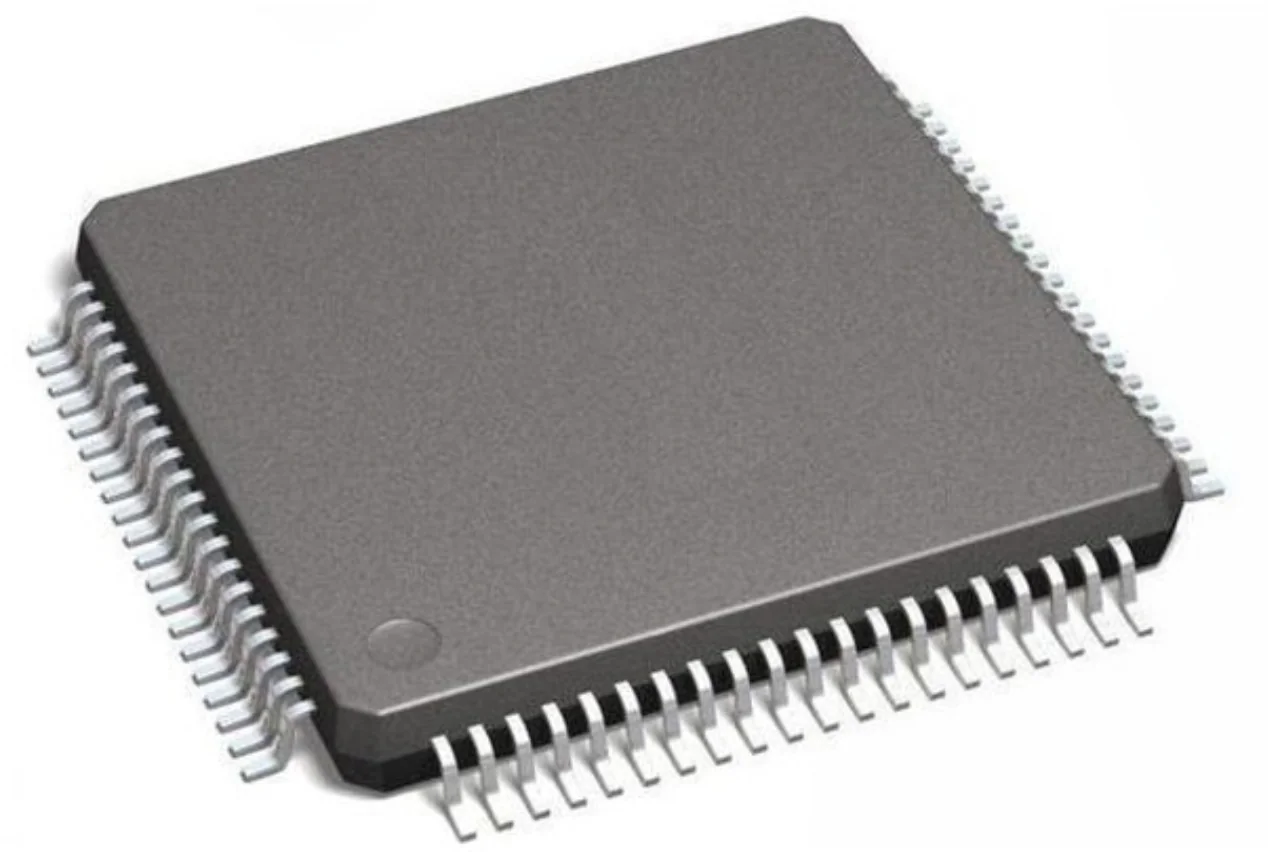
One available component in our inventory is STM32F103C8T6, manufactured by ST and described as a 32-bit MCU with 64KB Flash in a 48-LQFP package. Stock is currently available. These specifications provide a concrete example of how memory capacity and package configuration can be considered alongside the controller’s intended role.
Applying Microcontroller Concepts To Different Systems
The same class of controller can serve very different purposes depending on firmware and hardware requirements. Sensor equipment may focus on data acquisition and communication, while industrial control hardware can place greater emphasis on deterministic timing and actuator coordination. Consumer devices may instead prioritize compact construction and responsive interfaces.
Real-time behavior deserves attention whenever external events must trigger a rapid response. Interrupt priorities, timer resources, peripheral independence, and software scheduling all contribute to how predictably a controller handles concurrent activities. The processor itself is only one element of that response chain.
Development tools can influence implementation efficiency too. Familiar configuration utilities, debugging environments, programming tools, libraries, and reference materials can reduce unnecessary complexity during firmware development. A strong software ecosystem can also make it easier for teams to maintain established development practices across multiple projects.
For teams evaluating the STM32F103C8T6, the most useful question is not simply whether the controller has enough processing power. Its suitability becomes clearer after the workload, interface requirements, memory needs, power profile, PCB constraints, and development approach have been considered together.
Conclusion
Microcontroller selection becomes much clearer once the discussion moves beyond processor speed and into the relationships among firmware, peripherals, memory, timing, power, and board architecture. The STM32F103C8T6 microcontroller offers a useful case for examining that broader decision process because its 32-bit architecture, 64KB Flash specification, and 48-LQFP package illustrate several of the factors that shape embedded hardware choices.
We at Mayhwa approach component sourcing with the same system-level perspective, connecting individual specifications with the practical requirements of the application rather than viewing a microcontroller as an isolated part.