Artificial intelligence hardware places unusual demands on electronics manufacturing. Dense computing architectures, high-speed interfaces, thermal constraints, and increasingly compact circuit boards all depend on thousands of individual components working together.
Within that environment, electronic components sourcing involves much more than finding parts at an acceptable price; it also requires attention to specifications, availability, lifecycle status, and consistency across production batches. At Mayhwa, we view these factors as interconnected elements of a practical supply-chain strategy rather than isolated purchasing considerations.
Why AI Hardware Changes Component Requirements
AI computing platforms can generate substantial electrical activity because processors, accelerators, memory devices, networking interfaces, and power circuits often operate simultaneously. Supporting circuitry must respond to rapid changes in current demand while maintaining stable electrical performance.
Capacitors, resistors, inductors, connectors, and semiconductor devices each serve different functions within these architectures. A small passive component may appear insignificant compared with an accelerator, yet its electrical characteristics can influence power integrity, signal behavior, and noise performance across the board.
Miniaturization adds another layer of complexity. Higher component density allows manufacturers to fit more functionality into smaller assemblies, but it also reduces physical space for routing and thermal management. Component dimensions, placement, voltage ratings, tolerances, and temperature characteristics consequently become part of the broader hardware design equation.
Understanding The Role Of Passive Components
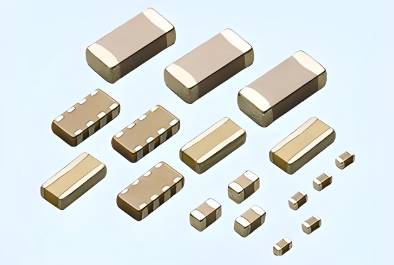
Multilayer ceramic capacitors, commonly known as MLCCs, illustrate how compact passive devices support sophisticated computing hardware. Their stacked ceramic construction provides capacitance in a small footprint, making them useful for filtering unwanted electrical fluctuations and supplying short-duration charge close to active devices.
Power distribution networks often place numerous capacitors near processors and other high-current components. Their combined behavior helps manage transient demand and reduce unwanted variations in supply voltage. Selecting capacitance alone, however, does not describe the complete electrical picture; equivalent series resistance, voltage rating, dielectric characteristics, temperature behavior, and package size may also matter.
Different capacitor technologies respond differently to mechanical and electrical conditions. Ceramic parts can be attractive where small dimensions and high-frequency performance are important, while other capacitor types may suit applications requiring different capacitance ranges or energy-storage characteristics. Understanding these distinctions helps hardware teams make decisions based on circuit behavior rather than component category alone.
Building A More Resilient Supply Network
AI hardware programs can experience rapid demand changes as computing architectures evolve and production forecasts shift. A sourcing strategy that depends heavily on one channel may become difficult to maintain if availability changes unexpectedly or a component reaches a different lifecycle stage.
An electronic components distributor can play a useful coordination role by connecting manufacturers with broader component networks and providing access to different device categories. The value of that relationship depends on technical communication, inventory visibility, documentation quality, and the ability to respond to changing requirements.
At Mayhwa, we work with component information across semiconductors and passive devices, while also considering package details, manufacturer references, stock conditions, and application requirements. Such an approach can help teams distinguish between a technically suitable substitute and a part that merely appears similar in a database.
Managing Data Across Complex Hardware Programs
AI hardware projects generate extensive component data. Part numbers, package variants, electrical ratings, manufacturer information, lifecycle notices, approved alternatives, and inventory records may all need to remain synchronized between engineering and supply-chain teams.
Data quality becomes especially important when several components have similar descriptions but different electrical characteristics. Two capacitors may share the same nominal capacitance while differing substantially in voltage rating, dielectric type, tolerance, or temperature behavior. Treating them as interchangeable without reviewing those distinctions can create downstream design problems.
Documentation should also remain connected to the specific component reference. Datasheets, compliance information, manufacturer declarations, inspection records, and revision histories provide useful context when a design moves from prototype production toward higher-volume manufacturing. A well-organized information trail makes technical decisions easier to revisit as the hardware evolves.
Planning Beyond Immediate Production Needs
AI hardware development rarely follows a perfectly static roadmap. Processor generations change, board layouts are revised, memory configurations evolve, and power requirements can shift as software workloads become more demanding. Component planning needs enough flexibility to accommodate those changes without disrupting the wider manufacturing process.
Effective electronic components sourcing can include lifecycle monitoring, alternative-part research, demand forecasting, and supplier diversification. These activities are particularly relevant for components that appear inexpensive but are used in very large quantities, since even a small availability problem can affect substantial production volumes.
The role of an electronic components distributor can extend beyond supplying individual part numbers. Technical clarification, stock information, sourcing channels, and component-level documentation can all contribute to better visibility across a complex hardware program. At Mayhwa, we use that broader perspective when supporting electronics projects, keeping the discussion focused on how component decisions interact with real production requirements.
Conclusion
AI hardware brings together demanding computational functions and an enormous supporting ecosystem of passive and active components. A small capacitor, connector, or protection device may occupy little board space, yet its electrical and physical characteristics can influence system stability, manufacturability, and scalability.
Successful component planning is consequently less about reacting to individual shortages and more about maintaining a clear view of specifications, alternatives, lifecycle conditions, and supply channels. We at Mayhwa approach this work with the goal of making component information more useful to the teams building increasingly dense and sophisticated electronic systems.